
2027: EVERYTHING HIDDEN Is About to Be EXPOSED! | Paul Selig
watch
INTRODUCTION
What if humanity’s greatest challenge isn’t simply changing the systems around us, but changing the consciousness from which those systems are created?
Spiritual teacher and channel Paul Selig has spent decades sharing teachings he attributes to a group of non-physical teachers he calls the Guides. At the center of their work is the idea that humanity is moving through a profound period of transformation, one that asks us to examine fear, separation, identity, and what we collectively believe is possible.
In this conversation on the Inspired Evolution Podcast, Paul explores what the Guides call the “upper room,” why fear can become an unreliable compass, and how individual transformation connects with the way we participate in the wider world. Paul is careful to distinguish these teachings from his own predictions or claims of enlightenment; he describes himself as the channel through which the material is communicated.
Subscribe On



Moving Beyond Fear and Separation
At the heart of Paul’s work is a spiritual premise: the divine isn’t somewhere outside of us waiting to be reached. According to the Guides, it is already present within people, nature, and the world around us.
The difficulty is that we often experience ourselves through separation.
We divide the world into ourselves and others, safe and dangerous, worthy and unworthy. According to the Guides’ framework, fear reinforces this separation, influencing both our individual choices and the larger structures humanity creates.
This is why Paul describes fear as a poor compass.
That doesn’t mean ignoring genuine danger.
If there’s a warning about sharks in the water, Paul jokes, don’t go swimming. Discernment still matters. The invitation is instead to notice when fear has moved beyond useful information and become the primary force directing our choices.
One teaching particularly changed Paul’s own life:
Notice when you’re acting from fear, and consider making another choice.
This distinction becomes important when looking at the world collectively.
Paul shares teachings about humanity entering a period of “reckoning,” during which structures created or sustained through fear may become increasingly difficult to maintain. The Guides have spoken through him about governments, education, medicine, war, inequality, and other human systems being confronted with the consequences of how they have operated.
Paul doesn’t present this as a prediction of sudden destruction.
Instead, the Guides describe transformation as happening in degrees and potentially across generations.
The point isn’t to watch the old world collapse.
It’s to ask what might be created differently.
The “Upper Room” and a Different Way of Seeing Reality
One of the central concepts in Paul’s teachings is what the Guides call the upper room.
They describe ordinary human reality as a shared field shaped by generations of ideas, expectations, labels, and beliefs. Paul refers to this as the common field.
We inherit assumptions about what people are like, what society should look like, what is possible, and even who we are supposed to become.
The upper room represents, within the Guides’ spiritual framework, another level of consciousness—what they sometimes associate with Christ consciousness or a “higher octave.”
Importantly, it isn’t presented as somewhere we escape to.
Paul describes it as a different way of encountering the same world.
A recurring theme in the teachings is that what we continually name, condemn, expect, and reinforce affects our relationship with reality. The Guides therefore invite people to recognize what they describe as the inherent divine even in places where it has been forgotten or denied.
That includes how we understand ourselves.
Paul shares three statements frequently used within the teachings:
I know who I am in truth.
I know what I am in truth.
I know how I serve in truth.
The intention is to move beyond identities based entirely on personality, status, achievement, appearance, or social expectations.
That doesn’t mean eliminating the personality.
Paul emphasizes that the human self isn’t the enemy. The work, as he understands it, is allowing aspects of ourselves built around fear and separation to change rather than trying to destroy the ego or escape ordinary life.
In fact, he argues that genuine spiritual development should make us more accountable to life, not less.
Spirituality Becomes Real Through How We Live
Perhaps the most grounded part of the conversation comes when Amrit asks what all of this means when confronted with real suffering.
If transformation is happening at the level of consciousness, does that mean we simply wait for humanity to awaken?
Paul’s answer is clear: no.
If your neighbor needs food, feed your neighbor.
There is still what he calls the “work of the hands”—the practical actions required to care for one another and respond to the world in front of us.
Paul also pushes back against a potentially harmful interpretation of spiritual manifestation: the idea that people individually create every illness, tragedy, or painful event that happens to them.
If a community becomes sick because chemicals were dumped into its water supply, he explains, the individuals who became ill didn’t personally “manifest” their disease.
The Guides instead frame responsibility collectively. We participate in societies that normalize certain conditions, and therefore we can also participate in changing what those societies accept.
That distinction moves the conversation away from blame and toward responsibility.
Paul’s approach to channeling follows a similar emphasis on discernment.
He openly questions the Guides when something doesn’t make sense to him. He also encourages others not to accept spiritual information simply because someone claims it came from a non-physical source.
As he humorously points out, not having a body doesn’t automatically make someone wise.
Receptivity therefore needs discernment.
If something doesn’t feel true or appropriate for you, Paul believes that response deserves to be respected.
Ultimately, his teachings return to possibility.
Rather than relying solely on hope, the Guides use the phrase:
“It can be so.”
For Paul, this means allowing ourselves to recognize a possibility before knowing exactly how it will become real.
Transformation may not arrive through one dramatic moment.
It may happen gradually—person by person, choice by choice, generation by generation.
Key Takeaways
Paul attributes his teachings to a group of non-physical teachers he calls the Guides.
Central to their teachings is the idea that the divine is already present within people and the world rather than somewhere separate from us.
The Guides describe fear and separation as major forces shaping individual and collective experience.
Paul distinguishes fear from discernment: recognizing genuine danger doesn’t require allowing fear to direct every decision.
The “upper room” describes what the Guides consider a higher level of consciousness that can still be embodied in ordinary life.
The personality or ego isn’t something that needs to be destroyed; Paul describes transformation as allowing fear-based aspects of identity to change.
Paul rejects the idea that individuals should be blamed for every illness or tragedy they experience.
Spiritual transformation doesn’t replace practical action—helping and caring for others remains essential.
Paul encourages discernment even when engaging with channeling or other spiritual teachings.
The Guides’ phrase “It can be so” represents a willingness to recognize a new possibility before knowing exactly how it will unfold.
Conclusion
Paul Selig’s work presents a spiritual vision of humanity moving beyond patterns rooted in fear and separation toward greater awareness of our interconnectedness.
Whether understood literally as channeled teachings or explored as a spiritual framework, one of the most practical questions emerging from the conversation is simple:
What are we creating from?
Fear or discernment?
Separation or connection?
Condemnation or the willingness to see differently?
Paul doesn’t claim to know exactly when or how humanity will change. In fact, he repeatedly resists making predictions and acknowledges that the transformation described by the Guides may unfold over generations.
But he also insists that spiritual transformation isn’t permission to withdraw from the world.
It asks more of us.
Care for the person in front of you.
Question the fear directing your choices.
Remain receptive without abandoning discernment.
And begin making room for the possibility that the world we inherited doesn’t have to be the only world we know how to create.
Related Resources
🌿 Join The Circle → inspiredevolution.com/circle
Weekly, live guided meditations, Q&As with podcast guests, and community connection. Join the movement today.
📚 Explore Dr. Suhas Kshirsagar’s teachings → ayurvedichealing.net
Learn more about Ayurvedic lifestyle medicine and personalized healing approaches.
🌀 Ground Yourself Naturally → Shop the full Earthing® catalog and use code INSPIRE to save 10%.
Stay Inspired, Keep Evolving,
Amrit
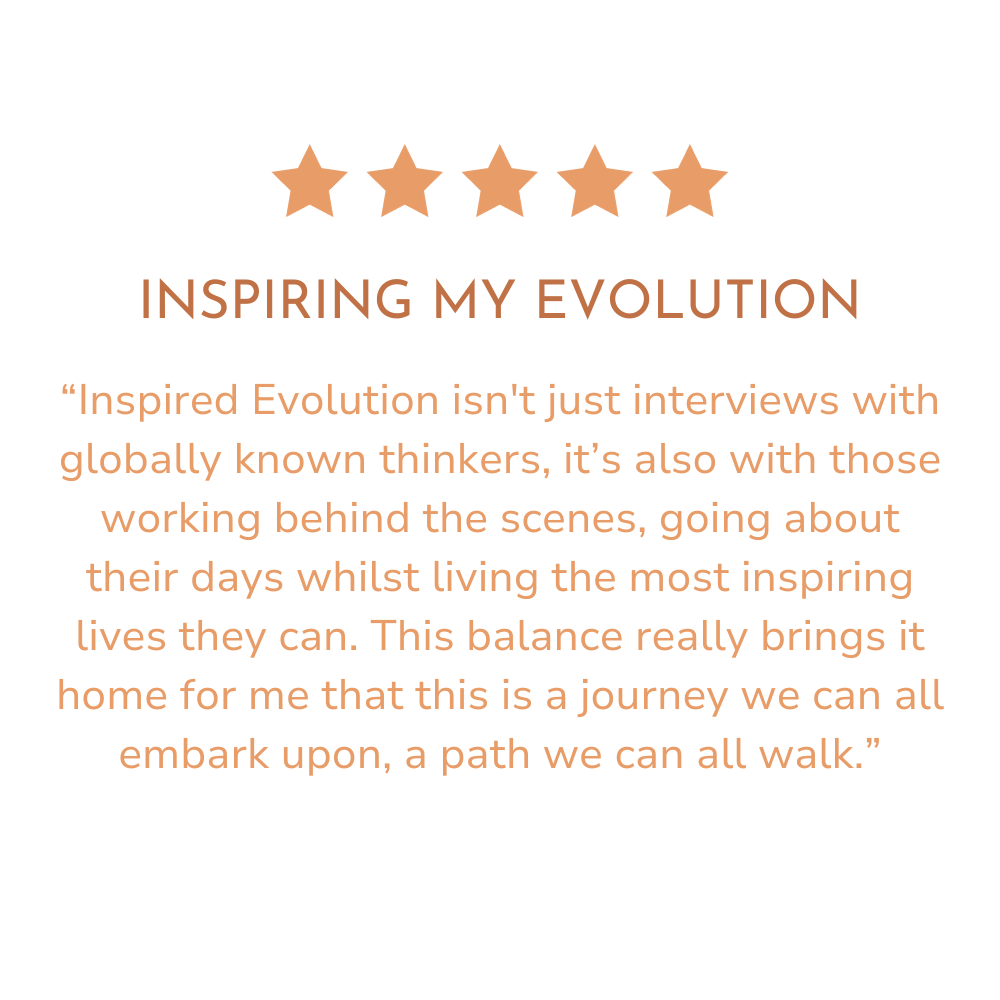
did you enjoy this episode?
please leave a review on


